
Your Goals Come First.
Understanding the whole picture helps us get there.
Every patient comes in with a different reason for considering orthodontic treatment. A parent may be thinking about healthy growth and timing. An adult may care most about improving their smile discreetly. Someone else may already know they want Invisalign, braces or help with a bite or jaw concern.
Dr. Chantal Hakim starts by listening to those goals, then looking carefully at the clinical picture behind them.
As a board-certified orthodontist in Los Angeles and co-owner of the Orthospaceship – Hakim Orthodontics, Dr. Chantal treats children, teens and adults using a Whole-Health approach that considers the teeth alongside the bite, jaws, joints, facial development and airway.
Her role isn’t simply to tell patients what treatment to choose. It is to help them understand what she sees, explain the options that can realistically achieve their goals, and build a plan that makes sense for the person—not just the teeth.

Dr. Chantal Hakim of The Orthospaceship
Why Dr. Chantal looks beyond what’s obvious
Dr. Chantal’s interest in airway and facial development began through her education and specialty training, but it became much more personal when she saw what her husband experienced.
He had airway problems as a child that went unaddressed and required far more involved treatment as an adult.
That experience stayed with her. It reinforced her belief that the value of evaluating a child during growth is not simply finding reasons to begin treatment earlier. It is recognizing when growth creates an opportunity to make a meaningful difference—and when watching and waiting is the better choice.
As a mother herself, that judgment has become even more personal to Dr. Chantal.
“As a mom, I want the same thing for my patients that I want for my own son: to make a meaningful difference for a child without doing more than they truly need.”
For some children, that means using a window of growth when treatment can help guide development. For others, the right plan is careful observation until the timing makes more sense.
The goal is to understand enough to know when treatment can make a meaningful difference.
A Different Starting Point
The jaw relationship before the tooth position
Straight teeth are only one part of an orthodontic result. Where the teeth end up also determines how the upper and lower teeth come together.
That raises an important treatment-planning question: What should serve as the reference point before the teeth begin moving?
The teeth can be moved almost anywhere. The jaw joint cannot. That makes the joint the one part of the system stable enough to plan from.
At the Orthospaceship, Dr. Chantal and Dr. Isaac begin by establishing the relationship between the upper and lower jaws independently of how the teeth currently fit together. Every case is mounted on an articulator and studied in centric relation before treatment is planned.
Why does that matter?
When you bite down, your teeth meet in the position where they currently fit together. Centric relation gives the doctors a repeatable reference for studying the jaw relationship without using that tooth contact as the starting point.
An articulator then allows them to reproduce and study those relationships outside the mouth.
This gives Dr. Chantal another layer of information before deciding where the teeth should move.
Two patients can have teeth that look similarly crowded or crooked while the relationship between their jaws and their bites is quite different. Studying both helps her see those differences before building the treatment plan around them.
The distinction at The Orthospaceship is not simply that the doctors “look at the bite.” Studying every case in centric relation on an articulator is part of their standard treatment-planning protocol, including cases that may ultimately require relatively straightforward orthodontic treatment.
The goal is to plan the tooth movement with the jaw relationship, bite, facial structure and treatment goals considered together—rather than treating alignment as a separate problem to solve.

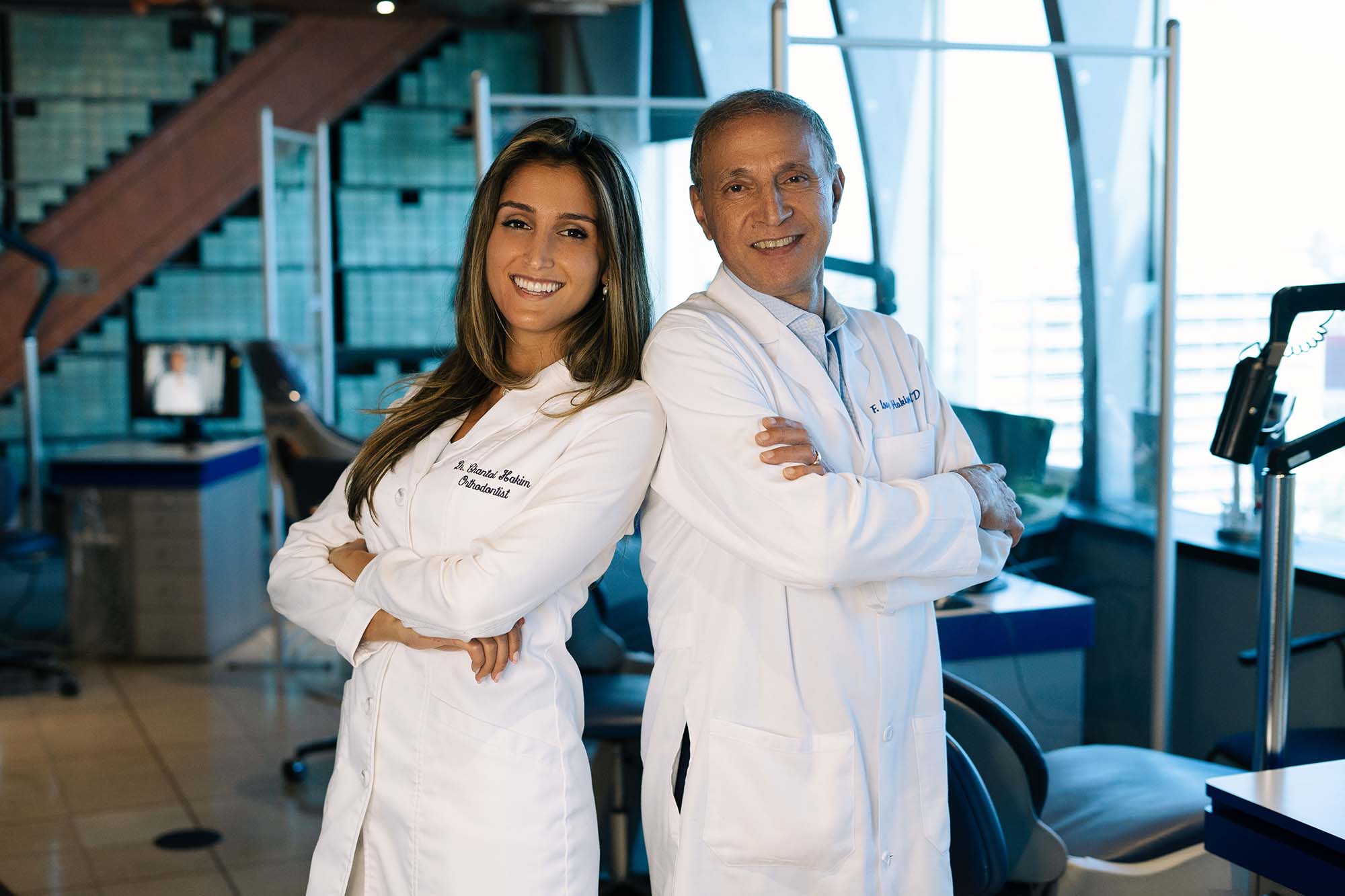
Dr. Chantal Hakim and Dr. F. Isaac Hakim examine a patient.
A whole-health approach leads to a better treatment plan
Whole-Health orthodontics evaluates tooth position within the larger relationships among the bite, jaw joints, facial growth, airway and surrounding structures. The goal is to understand the complete orthodontic picture before deciding how teeth should move, which treatment is appropriate and when treatment is most useful.
For Dr. Chantal, this is not a separate type of orthodontics added onto conventional treatment. It is a way of evaluating every case.
Her diagnostic process may include:
- the relationship between the upper and lower jaws
- how the teeth contact when the bite comes together
- the position and function of the jaw joints
- facial growth and development in younger patients
- airway-related findings that may be relevant to orthodontic planning
- existing dental health and previous dental or orthodontic treatment
- facial and dental proportions
- the patient’s goals, concerns and long-term treatment priorities
The practice also uses in-house DEXIS i-CAT FLX V CBCT 3D imaging, iTero digital scanning and Dolphin Imaging when those tools are appropriate to the evaluation.
Technology gives Dr. Chantal more information. Her judgment determines what that information means.
Learn more about The Orthospaceship’s whole-health approach.
The training behind that clinical perspective
Once you understand how Dr. Chantal thinks about treatment, her education and training make more sense. Her clinical perspective was built through years of study in biology, dentistry, orthodontics, facial development, airway and craniofacial research.
Board Certified by the American Board of Orthodontics
Dr. Chantal has been board certified by the American Board of Orthodontics since 2020.
Board certification is voluntary and requires additional examination and clinical evaluation beyond completing an accredited orthodontic residency. It gives patients an independent, verifiable measure of her commitment to the standards of her specialty.
UCLA School of Dentistry
Dr. Chantal earned her Doctor of Dental Surgery degree from the UCLA School of Dentistry in 2018, graduating at the top of her class.
While at UCLA, she:
- received the Dean’s Scholarship
- served as president of the dental student body
- conducted research involving osteonecrosis of the jaw
- won the Scientific Dental Student category of the UCLA Table Clinic Competition in 2017
Before dental school, she earned a B.S. in Biological Sciences from UC Santa Barbara in 2014 and graduated through the university’s Honors Program.
Orthodontic Residency and Master of Science in Dentistry
Dr. Chantal completed her orthodontic residency at the University of the Pacific, Arthur A. Dugoni School of Dentistry earning both her Certificate in Orthodontics and Master of Science in Dentistry in 2020.
Her residency included training in:
- MARPE
- temporary anchorage devices, or TADs
- advanced radiology
- complex orthodontic diagnosis and treatment planning
During her residency in 2019, she also completed a rotation at the Stanford Sleep Clinic. The rotation contributed to the airway knowledge she now brings into orthodontic evaluation.
Research into how the face develops
Dr. Chantal’s graduate research focused on craniofacial development at a biological level.
Her master’s thesis studied genetic factors associated with nonsyndromic orofacial clefting and was co-authored with Marie M. Tolarova, MD, PhD, DrSc, and Miroslav Tolar, MD, PhD, through the University of the Pacific.
Published Graduate Thesis
Association of Type and Severity of Nonsyndromic Orofacial Clefts with Combined Genotypes of RFC1 80 G>A, MTHFR 677 C>T, IRF6 (rs642961) and IRF6 (rs2235371) Gene Polymorphisms in an Indian Population
Authors: Chantal Hakim, Marie M. Tolarova, MD, PhD, DrSc, and Miroslav Tolar, MD, PhD
Published: University of the Pacific, 2020
She also participated in additional research involving BMP4 and orofacial clefts.
The research does not mean every orthodontic problem is genetic, nor does it replace clinical diagnosis. Its value is in the depth of understanding it gave Dr. Chantal about how facial structures form and develop… knowledge that fits naturally with the way she now evaluates growing patients.
Complex cases have been part of her clinical world from the start
Dr. Chantal has personally treated 500+ patients since completing her orthodontic residency and joining The Orthospaceship.
What adds unusual depth to those years is the clinical environment in which she has practiced.
As a second-generation orthodontist, Dr. Chantal works side by side with her father, Dr. F. Isaac Hakim, who founded the practice in Los Angeles in 1978. They review and discuss cases together, combining her contemporary orthodontic training with the perspective that comes from more than four decades of treating patients.
That means Dr. Chantal has spent her career immersed not only in everyday orthodontics, but in a practice where complex bite relationships, TMJ/TMD, airway and growth concerns, lingual orthodontics and surgical cases are familiar territory.
Over time, that kind of exposure builds something textbooks alone cannot: the ability to recognize patterns, notice subtleties and understand when a case calls for deeper investigation—and when a straightforward, more simple approach is exactly what is needed.
A Practice Built on Broad Clinical Experience
Across its history, The Orthospaceship has treated more than:
- 8,000+ patients
- 1,500+ TMJ/TMD cases
- 2,000+ airway and pediatric growth cases
- 500+ lingual braces cases
Dentists, physicians and other specialists also refer patients to the practice for complex adult bite problems, early-intervention concerns, airway issues, TMJ/TMD and surgical orthodontic cases, including patients referred from outside Los Angeles.
For patients, the value is not that every case is complicated.
It is knowing that their orthodontist practices in an environment where complicated cases are understood—and that experience can make it easier to recognize when a simpler solution is all that is needed.
Where decades of experience meet a new generation of orthodontics
Dr. Chantal grew up around orthodontics, but she did not simply step into her father’s career.
She built her own academic record, completed her own research and specialty training, earned her own board certification and developed a clinical perspective shaped by a newer generation of orthodontic education.
Today, father and daughter bring different kinds of experience to the same patient.
Dr. Isaac brings more than four decades of clinical experience and advanced training in functional occlusion.
Dr. Chantal brings contemporary specialty training, craniofacial research, airway exposure, modern diagnostic technology and her own growing body of treated cases.
They study cases together without assuming that experience belongs to only one generation.
This exchange is an important part of The Orthospaceship’s clinical culture and a huge advantage for its patients.

Different stages of life call for different orthodontic decisions
Approximately half of The Orthospaceship’s current patients are adults, giving Dr. Chantal experience across very different orthodontic decision points.
Children and Growing Patients
With children, timing matters. Dr. Chantal evaluates the developing bite alongside jaw growth, facial development, airway-related findings and the transition from baby teeth to permanent teeth.
When early treatment can meaningfully influence development, she explains why. When observation is the better choice, she explains that too.
The objective is not simply to start orthodontics early. It is to recognize when growth creates an opportunity worth using.
Teen Orthodontics
Teen treatment may involve braces, clear aligners or other orthodontic appliances depending on the bite, growth pattern and goals of the patient.
Dr. Chantal also considers the practical side of treatment: oral hygiene, compliance, daily habits and which option a teenager can realistically manage.
The technically ideal treatment only works when it works for the patient living with it.
Adult Orthodontics
Adult orthodontic treatment often starts from a different place.
Some patients want to straighten teeth they have thought about for years. Others come in because teeth have shifted after previous orthodontics, their bite has changed, they have TMJ-related concerns, or treatment needs to coordinate with restorative dentists, oral surgeons or other specialists.
Dr. Chantal evaluates the existing dental condition, jaw and bite relationships, treatment history and the patient’s priorities before recommending a path forward.

A female orthodontist in Los Angeles who wants you to understand the “why”
Patients consistently describe The Orthospaceship as thorough, detail-oriented and willing to spend time looking for answers. One theme appears again and again: the doctors explain what they are seeing.
That matters to Dr. Chantal.
She does not want a parent agreeing to treatment because an orthodontist handed them a recommendation they felt unqualified to question. She wants them to understand what she sees, why it matters and what the options actually mean.
Adults deserve the same clarity.
During the consultation, Dr. Chantal can review imaging, explain relevant findings and walk through the relationships she is considering before discussing treatment. The goal is not simply for you to leave knowing what she recommends. It is for you to understand why.
Teaching and professional involvement
Dr. Chantal has also shared her orthodontic knowledge with other dental professionals, including lecturing to the Los Angeles Dental Society on ways general dentists can simplify clear aligner treatment.
Her professional memberships include:
- American Association of Orthodontists, member since 2018
- Pacific Coast Society of Orthodontists, member since 2018<
- Beverly Hills Academy of Dentistry, member since 2023
She holds California Dental License #104606, issued in 2019.
Personalized care in English, Spanish and Farsi
Dr. Chantal speaks English, Spanish and Farsi fluently with patients.
Orthodontic treatment can involve detailed conversations about diagnosis, treatment choices, instructions and progress over months or years. Being able to have those conversations directly in a patient’s or parent’s preferred language can make an already complex decision much easier to understand.
Dr. Chantal treats patients at The Orthospaceship on Sunset Boulevard in Los Angeles, conveniently located near West Hollywood and Beverly Hills.
Dr. Chantal Hakim, DDS, MSD
Credentials at a glance
Dr. Chantal Hakim, DDS, MSD, is a board-certified orthodontist and co-owner of The Orthospaceship in Los Angeles. She treats children, teens and adults, and plans every case from the jaw joint outward, using an articulator to establish how the jaw closes before deciding how teeth should move. Her clinical focus includes airway and facial growth in children, jaw joint function, and adult treatment.
Name: Dr. Chantal Hakim, DDS, MSD
Role: Lead Orthodontist and Co-Owner, The Orthospaceship – Hakim Orthodontics
Specialty: Orthodontics
Board Certification: American Board of Orthodontics, active since 2020
DDS: UCLA School of Dentistry, 2018 — graduated top of class
Certificate in Orthodontics: University of the Pacific, Arthur A. Dugoni School of Dentistry, 2020
Master of Science in Dentistry: University of the Pacific, 2020
Airway Training: Stanford Sleep Clinic rotation during orthodontic residency, 2019
Research: Published graduate thesis examining genetic factors associated with nonsyndromic orofacial clefting
California Dental License: #104606
Languages: English, Spanish and Farsi
Patients: Children, teens and adults
Location: 9201 Sunset Blvd, Suite 905, Los Angeles, CA 90069
Start by understanding what’s really going on
You do not need to decide whether you or your child needs braces, clear aligners, early treatment—or any treatment at all—before walking through our doors.
That is what the first conversation is designed to help you understand.
Complimentary consultations at The Orthospaceship include a functional exam and assessment so Dr. Chantal can tell you what she sees, explain what matters and help you understand the options before you make a decision.
If you’re looking for a board-certified orthodontist in Los Angeles who takes the time to study the whole case before recommending what comes next, schedule a complimentary consultation with Dr. Chantal Hakim.